
When markets are strong, investors tend to focus on growth. But when inflation rises, interest rates shift, or geopolitical tensions make headlines, attention often turns to protection. In those moments, one asset class frequently moves back into the spotlight: precious metals.
Gold and silver have played a role in the financial system for centuries. Even in today’s modern markets, many investors continue to consider them part of a diversified portfolio.
Why Investors Pay Attention to Gold
Gold is often discussed as a “store of value” because it has been used as a monetary and financial asset for long periods of time. However, gold prices can be volatile—sometimes for extended stretches—and its performance can differ meaningfully across market environments.
Investors may focus on gold during periods of elevated inflation concerns, currency movements, or broader market uncertainty because it has, at times, behaved differently than traditional stocks and bonds. That said, there is no guarantee gold will rise during inflationary periods or decline less than other assets during market stress.
In recent years, some central banks have increased their reported gold reserves as part of broader reserve-management and diversification efforts. These actions can influence market sentiment, but they are only one of many factors that affect gold prices.
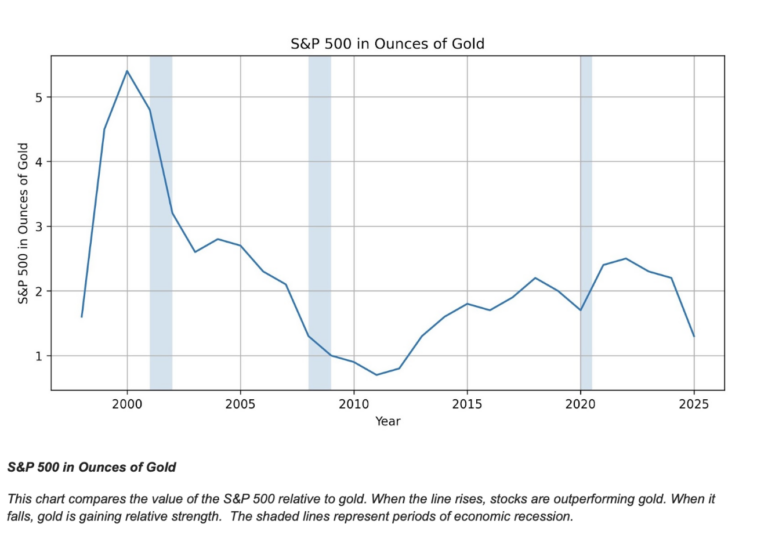
Another way investors assess gold’s role is by looking at its performance relative to equities, sometimes expressed as the S&P 500-to-gold ratio. When the ratio rises, equities have outperformed gold over that period; when it falls, gold has outperformed equities. Like any ratio, this is descriptive rather than predictive—and shifts can be driven by a wide range of economic and market factors.
Historically, leadership between stocks and gold has rotated. There have been periods when equities significantly outpaced gold (for example, parts of the late 1990s), and periods when gold held up better than stocks (including some market stress and recovery windows). Past performance, however, is not indicative of future results.
When Markets Move Together
Gold is often viewed as a diversification tool because it has historically behaved differently from stocks and bonds. However, markets rarely follow simple patterns.
At times, gold and equities can move in the same direction for extended periods. When this happens, the diversification benefit may be less noticeable in the short term. Over longer periods, however, precious metals have often added a different return pattern alongside traditional investments.
Silver: A Precious Metal with an Industrial Side
While gold often receives the most attention, silver plays a unique role in global markets.
In addition to being held as a precious metal, silver is widely used in electronics, solar panels, medical technologies, and other industrial applications. Because of this dual role, silver prices tend to respond more strongly to changes in economic activity and are often more volatile than gold.
Investors sometimes track the relationship between these two metals using the gold-to-silver ratio, which measures how many ounces of silver are needed to buy one ounce of gold.
The ratio reached unusually high levels during the early months of the 2020 pandemic as investors rushed toward gold while industrial demand for silver temporarily weakened. As economic activity recovered, the ratio gradually moved back toward more typical ranges.
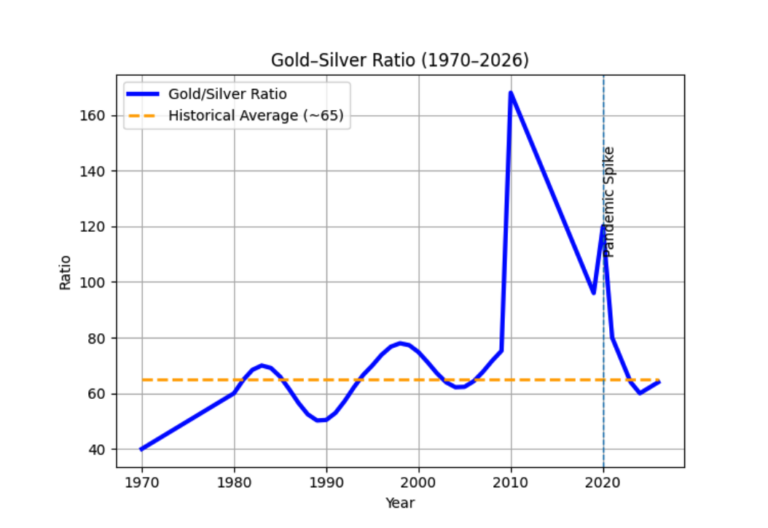
Source: London Bullion Market Association (LBMA) Gold Price and LBMA Silver Price (USD). Gold/Silver Ratio = (Gold price per troy ounce) ÷ (Silver price per troy ounce).
Historical average reflects the period shown. Calculations by Village Wealth Advisors.
The Bottom Line
Equities remain the primary driver of long-term portfolio growth. However, a modest allocation to precious metals can help add another layer of diversification and prepare a portfolio for a wider range of market environments.
Gold and silver do not generate income through dividends or interest payments. Instead, their prices are influenced by supply and demand, investor sentiment, inflation expectations, and broader economic conditions.
What This Means for Our Clients
For VWA clients, commodities may serve a specific purpose within the broader portfolio. Holdings such as gold, silver, energy, and other commodity exposures are generally intended to provide diversification and a potential source of liquidity during certain market environments—an “in case of emergency” sleeve that may help reduce the need to sell stocks or bonds at depressed prices during a severe drawdown.
Importantly, commodities can be volatile and may decline at the same time as stocks and bonds, particularly during periods when correlations rise. There is no guarantee that any allocation will offset losses elsewhere or provide a specific amount of spending coverage. The size, implementation, and rebalancing of any commodities exposure are tailored to a client’s objectives, risk tolerance, tax considerations, and overall financial plan.
A recent example of a period in which some commodity exposures performed differently than many traditional assets occurred in 2022; however, market relationships vary over time and past performance is not indicative of future results.
At VWA, we continuously monitor market conditions and portfolio allocations to help ensure our clients are prepared for a wide range of market environments.
General Disclaimer: Village Wealth Advisors (VWA) is a registered investment advisor with the SEC. Registration does not imply a certain level of skill or training. All opinions and estimates constitute Village Wealth Advisor’s judgement at the date of this communication and are subject to change without notice. Village Wealth Advisors does not warrant that the information will be free from error. The information should not be relied upon for purposes of transacting securities or other investments. Your use of the information is at your sole risk. The information mentioned is not intended as an offer or solicitation of an offer to buy or sell, or as an endorsement of any company, security, fund, or other securities or non-securities offering. This communication should not be relied upon as the sole factor in an investment decision. Under no circumstances shall Village Wealth Advisors be liable for any direct, indirect, special or consequential damages that result from the use of, or the inability to use, the information provided herein, even if Village Wealth Advisors has been advised of the possibility of such damages. Information contained herein should not be considered a solicitation to buy, an offer to sell, or a recommendation of any security in any jurisdiction where such offer, solicitation, or recommendation would be unlawful or unauthorized. The information herein is provided “AS IS” and without warranties of any kind either express or implied. To the fullest extent permissible pursuant to applicable laws, Village Wealth Advisors disclaims all warranties, express or implied, including, but not limited to, implied warranties or merchantability, non-infringement, and suitability for a particular purpose.
Investing in commodities involves significant risk, including the potential loss of principal, and is not suitable for all investors. The information contained herein does not constitute a solicitation to buy or sell any commodity or security. Please consult with a qualified financial advisors before making any investment decisions.
